Thursday, April 8, 2021

Business Law & Regulation

Business Law Regulation

Implementation and regulation of various laws and policies concerned with businesses in all economic sectors are of paramount importance for secured sustainability and desired development and prosperity. For these purposes there are diverse business law regulation acts in every country, apart from the company and corporate law, commercial law, taxation law, and laws relating to exports and imports and international business. Our discerning and reputed law firm with worldwide prominence provides the full-range of services regarding the business law implementation and regulation, along with all other supportive legal services to people and entities in diverse economic sectors in jurisdictions worldwide. Ours flawless and rigorous legal services cover all disciplines of the law and all areas of the legal practice, for great benefits of businesses in all sectors. Besides, swift services for domestic business law regulation, we also adroitly support our clients for their business management and regulation at international level worldwide, to facilitate and promote their international businesses.


Business Law Regulation in India

For punctual and perfect business law regulation in India, ours veteran and mellow legal professionals have been offering legal service regarding various business regulation acts, in every part of India. The most prominent and significant among these acts are - New Companies Act, 2013; Competition Act, 2002; FEMA, 1999; Foreign Trade (Development and Regulation) Act, 1992; SEBI Act, 1992; Industries (Development and Regulation) Act, 1951; Income Tax Act, 1961; Reserve bank of India Act, 1934; Contracts Act, 1872; Factories Act, 1948 and the Mines Act, 1952; Industrial Disputes Act, 1947 and the Trade Unions Act, 1926; and several other regulations of the Government of India issued from time to time. Ours these services to businesses in all sectors are in addition to the extensive range of legal services regarding the business and commercial law, intellectual property law and rights, maritime and admiralty law, real estate and construction law, pollution and environmental law, labor and employment law, alternative dispute resolution, international business laws, and so on.

Company Act

Ours this elaborately and meticulously written article offers precious description about what is company act, the company act in India, and ours impeccable and swift services in connection with this company act, along with giving the proper definition of company act. The Company Act or Company Law is the paramount and vital legislation regarding the formation, incorporation, governance, management, regulation, and winding up of all types of entities in all economic sectors within the specified country. In India, this company law is represented by the New Companies Act, 2013, detailed information about this being offered in the section below. Our organization has been one of the most famous and reputed law firms in the world, with whole gamut of refined and brisk services to people and entities in all economic sectors worldwide, essentially including the company act or law. All diverse disciplines of the legal practice are well-served by ours internationally eminent and reputed legal professionals. All different matters and issues contained in the company acts in sovereign nations located in all across the world, are well-served adroitly by ours mellow and discerning company law solicitors and attorneys.

Company Act 1956 India


The New Companies Act, 2013 provides the central government of India, the exclusive rights to incorporate, regulate, control, and terminate all various categories of entities in diverse sectors located within the country. The ministry of corporate affairs, company law board, registrars of companies in various States, and other agencies and authorities are responsible for supervising and regulating proper and strict compliance's under the rules and regulations of the companies act, and business regulation policies of the central government of India. Apart from the formation and functioning of profit-making and commercial entities like the private limited companies, partnership firms, sole proprietorship, public limited companies, One Person Company and unlimited companies, etc., this New Companies Act, 2013 also governs and regulates the inception and functioning of the non-profit-making companies under its Section 8. Establishments of diverse entities in India by foreign companies and investors, such as representative office, project office, liaison office, branch office, joint ventures, fully-owned subsidiaries, etc., are also exclusively governed and controlled by this magnificent New Companies Act, 2013. Well-established in India, ours respected and popular law firms extends all services related with the New Companies Act, 2013, governmental business regulation policies, and international business, to entities situated in all around the whole country.

The Sale of Goods Act 1930

Contracts or agreements related to the sale of goods are governed under the Sale of Goods Act 1930. This act came into effect on the 1st of July 1930 in the whole of India except the state of Jammu and Kashmir. Let us learn some important definitions and provisions of the act.

Definitions of Important Terms

Sale of commodities constitutes one of the important types of contracts under the law in India. India is one of the largest economies and also a great country where and thus has adequate checks and measures to ensure the safety and prosperity of its business and commerce community. Here we shall explain The Sale of Goods Act, 1930 which defines and states terms related to the sale of goods and exchange of commodities.

Sale of Goods Act, 1930 – Important Terms

The Sale of Goods Act, 1930 herein referred to as the Act, is the law that governs the sale of goods in all parts of India. It doesn’t apply to the state of Jammu & Kashmir. The Act defines various terms which are contained in the act itself. Let us see below:

I. Buyer And Seller

As per the sec 2(1) of the Act, a buyer is someone who buys or has agreed to buy goods. Since a sale constitutes a contract between two parties, a buyer is one of the parties to the contract.

The Act defines seller in sec 2(13). A seller is someone who sells or has agreed to sell goods. For a sales contract to come into existence, both the buyers and seller must be defined by the Act. These two terms represent the two parties of a sales contract.

A faint difference between the definition of buyer and seller established by the Act and the colloquial meaning of buyer and seller is that as per the act, even the person who agrees to buy or sell is qualified as a buyer or a seller. The actual transfer of goods doesn’t have to take place for the identification of the two parties of a sales contract.

II. Goods

One of the most crucial terms to define is the goods that are to be included in the contract for sale. The Act defines the term “Goods” in its sec 2(7) as all types of movable property. The sec 2(7) of the Act goes as follows:

“Every kind of movable property other than actionable claims and money; and includes stock and shares, growing crops, grass, and things attached to or forming part of the land which are agreed to be severed before sale or under the contract of sale will be considered goods”

As you can see, shares and stocks are also defined as goods by the Act. The term actionable claims mean those claims which are eligible to be enforced or initiated by a suit or legal action. This means that those claims where an action such as recovery by auction, suit, refunds etc. could be initiated to recover or realize the claim.

Business Law & Regulation notes PDF


1. Existing Goods

The goods that are referred to in the contract of sale are termed as existing goods if they are present (in existence) at the time of the contract. In sec 6 of the Act, the existing goods are those goods which are in the legal possession or are owned by the seller at the time of the formulation of the contract of sale. The existing goods are further of the following types:

A) Specific Goods

According to the sec 2(14) of the Act, these are those goods that are “identified and agreed upon” when the contract of sale is formed. For example, you want to sell your mobile phone online. You put an advertisement with its picture and information. A buyer agrees to the sale and a contract is formed. The mobile, in this case, is specific good.

B) Ascertained Goods:

This is a type not defined by the law but by the judicial interpretation. This term is used for specific goods which have been selected from a larger set of goods. For example, you have 500 apples. Out of these 500 apples, you decide to sell 200 apples. To sell these 200 apples, you will need to separate them from the 500 (larger set). Thus you specify 200 apples from a larger group of unspecified apples. These 200 apples are now the ascertained goods.

C) Unascertained Goods:

These are the goods that have not been specifically identified but have rather been left to be selected from a larger group. For example, from your 500 apples, you decide to sell 200 apples but you don’t specify which ones you want to sell. A seller will have the liberty to choose any 200 apples from the lot. These are thus the unascertained goods.

2. Future Goods

In sec 2(6) of the Act, future goods have been defined as the goods that will either be manufactured or produced or acquired by the seller at the time the contract of sale is made. The contract for the sale of future goods will never have the actual sale in it, it will always be an agreement to sell.

For example, you have an apple orchard with apples in it. You agree to sell 1000 apples to a buyer after the apples ripe. This is a sale that has to occur in the future but the goods have been identified already and the agreement made. Such goods are known as future goods.

3. Contingent Goods

Contingent goods are actually a sub type of future goods in the sense that in contingent goods the actual sale is to be done in the future. These goods are part of a sale contract that has some contingency clause in it. For example, if you sell your apples from your orchard when the trees are yet to produce apples, the apples are a contingent good. This sale is dependent on the condition that the trees are able to produce apples, which may not happen.

III. Delivery

The delivery of goods signifies the voluntary transfer of possession from one person to another. The objective or the end result of any such process which results in the goods coming into the possession of the buyer is a delivery process. The delivery could occur even when the goods are transferred to a person other than the buyer but who is authorized to hold the goods on behalf of the buyer.

There are various forms of delivery as follows:

·        Actual Delivery: If the goods are physically given into the possession of the buyer, the delivery is an actual delivery.

·        Constructive delivery: The transfer of goods can be done even when the transfer is effected without a change in the possession or custody of the goods. For example, a case of the delivery by attainment or acknowledgment will be a constructive delivery. If you pick up a parcel on behalf of your friend and agree to hold on to it for him, it is a constructive delivery.

·        Symbolic delivery: This kind of delivery involves the delivery of a thing in token of a transfer of some other thing. For example, the key of the go downs with the goods in it, when handed over to the buyer will constitute a symbolic delivery.

IV. The Document of Title to Goods

From the Sec 2(4) of the act, we can say that this “includes the bill of lading, dock-warrant, warehouse keeper’s certificate, railway receipt, multi modal transport document, warrant or order for the delivery of goods and any other document used in the ordinary course of business as proof of the possession or control of goods or authorizing or purporting to authorize, either by endorsement or by delivery, the possessor of the document to transfer or receive goods thereby represented.”

V. Mercantile Agent [Section 2(9)]

Mercantile agent is someone who has authority in the customary course of business, either to sell or consign goods under the contract on behalf of the one or both of the parties. Examples include auctioneers, brokers, factors etc.

VI. Property [Section 2(11)]

In the Act, property means ‘ownership’ or the general property i.e. all ownership right of the goods. A sale constitutes the transfer of ownership of goods by the seller to the buyer or an agreement of the same.

VII. Insolvent [Section 2(8)]

The Act defines an insolvent person as someone who ceases to pay his debts in the ordinary course of business or cannot pay his debts as they become due, whether he has committed an act of insolvency or not.

VIII. Price [Section 2(10)]

In the Act, the price is defined as the money consideration for a sale of goods.

IX. Quality of Goods

In Sec 2(12) of the Act, the quality of goods is referred to as their state or condition.


Sunday, April 4, 2021

Managerial Economics

Managerial Economics


Managerial economics is a stream of management studies which emphasizes solving business problems and decision-making by applying the theories and principles of microeconomics and macroeconomics. cost accounting It is a specialized stream dealing with the organisation’s internal issues by using various economic theories.

Nature of Managerial Economics

To know more about managerial economics, we must know about its various characteristics. Let us read about the nature of this concept in the following points:


Art and Science: Managerial economics requires a lot of logical thinking and creative skills for decision making or problem-solving. It is also considered to be a stream of science by some economist claiming that it involves the application of different economic principles, techniques and methods, to solve business problems.

Micro Economics: In managerial economics, managers generally deal with the problems related to a particular organisation instead of the whole economy. Therefore it is considered to be a part of microeconomics.

Uses Macro Economics: A business functions in an external environment, i.e. it serves the market, which is a part of the economy as a whole.

Therefore, it is essential for managers to analyse the different factors of macroeconomics such as market conditions, economic reforms, government policies, etc. and their impact on the organisation.

Multi-disciplinary: It uses many tools and principles belonging to various disciplines such as accounting, finance, statistics, mathematics, production, operation research, human resource, marketing etc.

Prescriptive / Normative Discipline: It aims at goal achievement and deals with practical situations or problems by implementing corrective measures.

Management Oriented: It acts as a tool in the hands of managers to deal with business-related problems and uncertainties appropriately. It also provides for goal establishment, policy formulation and effective decision making.

Pragmatic: It is a practical and logical approach towards the day to day business problems.

Types of Managerial Economics

All managers take the concept of managerial economics differently. Some may be more focused on customer’s satisfaction while others may prioritize efficient production.

Scope of Managerial Economics

Managerial economics is widely applied in organizations to deal with different business issues. Both the micro and macroeconomics equally impact the business and its functioning.


Micro-Economics Applied to Operational Issues

To resolve the organisation’s internal issues arising in business operations, the various theories or principles of microeconomics applied are as follows:

  • Theory of Demand: The demand theory emphasizes on the consumer’s behaviour towards a product or service. It takes into consideration the needs, wants, preferences and requirement of the consumers to enhance the production process.
  • Theory of Production and Production Decisions: This theory is majorly concerned with the volume of production, process, capital and labour required, cost involved, etc. It aims at maximizing the output to meet the customer’s demand.
  • Pricing Theory and Analysis of marketing structure  It focuses on the price determination of a product keeping in mind the competitors, market conditions, cost of production, maximization sales volume, etc.
  • Profit Analysis and Management: The organisations work for a profit. Therefore they always aim at profit maximization. It depends upon the market demand, cost of input, competition level, etc.
  • Theory of Capital and Investment Decisions: Capital is the most critical factor of business. This theory prevails the proper allocation of the organisation’s capital and making investment  in profitable projects or venture to improve organisational efficiency.

Macro-Economics Applied to Business Environment

Any organisation is much affected by the environment it operates in. The business environment can be classified as follows:

  • Economic Environment: The economic conditions of a country, GDP, economic policies, etc. indirectly impacts the business and its operations.
  • Social Environment: The society in which the organisation functions also affects it like employment conditions, trade unions, consumer cooperatives, etc.
  • Political Environment: The political structure of a country, whether authoritarian or democratic; political stability; and attitude towards the private sector, influence organizational growth and development.

Managerial economics provides an essential tool for determining the business goals and targets, the actual position of the organization, and what the management should do fill the gap between the two.

Henri Fayol’s 14 Principles of Management

Definition of Management: Management can be viewed as an effort made for accomplishing the organizational goals, objectives and vision through planning, organizing, staffing, directing and controlling all the business  activities accordingly. These principles set the guidelines and standardize the management’s course of action to run a business organization effectively and efficiently.

Though these principles are not very appropriate for the modern business world, they have laid the foundation of business management.

Also, they are studied and used by many researchers, experts and entrepreneurs, even today.

What are the Principles of Management?

The principles of management refer to the fundamental truth which is generally applied to the everyday business operations for ensuring effective management of the organization.

Features of Principles of Management

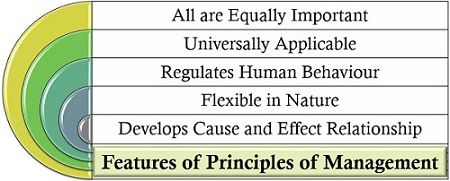
The principles of management are identified facts which are developed through individual experiences and can be applied to all kinds of business entities. To know more about these principles, let us go through its following characteristics:Features of Principles of Management

  • All are Equally Important: Every management principle holds equal importance in the business organization.
  • Universally Applicable: These principles can be applied to any kind of organization, whether large or small or belongs to any industry.
  • Regulates Human Behavior: The application of the management principles helps the organization to monitor and control the behaviour of the personnel.
  • Flexible in Nature: The applicability of these principles vary from organization to organization.
  • Develops Cause and Effect Relationship: The principles of management establishes a relationship between every action and its consequences in the short and long run.

Administrative Management and Henri Fayol

The concept of the administrative management stating the 14 principles of management was given by Henry Fayol (1841-1925) in his book published in the year 1916 under the name ‘General and Industrial Management‘.

Administrative Management and Henri Fayol

The concept of the administrative management stating the 14 principles of management was given by Henry Fayol (1841-1925) in his book published in the year 1916 under the name ‘General and Industrial Management

Administrative Management and Henri Fayol

The concept of the administrative management stating the 14 principles of management was given by Henry Fayol (1841-1925) in his book published in the year 1916 under the name ‘General and Industrial Management"

These principles have laid the foundation of what it is called modern management theory today. This theory is still applied by some of the famous companies like Apple, Google, Microsoft, etc. He is therefore known as the ‘father of modern management theory’.

Fayol worked for an iron and coal company named, ‘Commentry-Fourchambault‘ in France for 58 years, where he was a mining engineer in the initial years and lastly became the CEO of the company.

He gained ample understanding of the problems at all levels of the organization during his growth tenure.

Thus, through all his experience and learning, he developed the 14 principles for superior management of any organization.

Henry Fayol has himself followed these principles throughout his management career. Therefore, his motive was to provide a guideline to all the other managers for the efficient management of their organizations.

Fayol’s 6 Activities of Industry

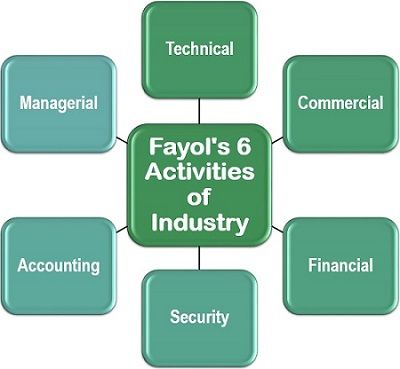
In his concept of administrative management, Fayol stated that there are six significant activities which are performed in every type of organization. These activities comprise of:Fayol's 6 Activities of Industry

  • Technical: The technical part includes product or process engineering and production of goods or services.
  • Commercial: All the marketing functions, including procurement, sales, distribution and promotion, are a part of commercial activity.
  • Financial: The financial activity consists of the acquisition of capital and its management.
  • Security: The protection and safety of the resources, i.e., personnel, capital and assets, comes under security.
  • Accounting: The accounting activity comprises of bookkeeping, record maintenance, reporting, cost accounting  inventory management, etc.
  • Managerial: Managerial activity includes the various functions of management, i.e., planning, organizing, commanding, coordinating and controlling of the business operations.

Fayol’s 6 Functions of Management

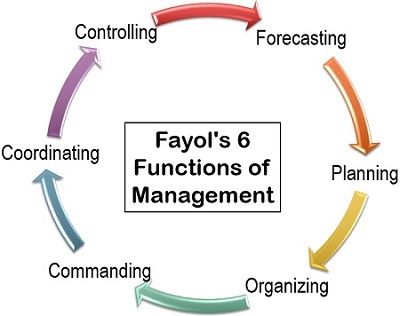
Henry Fayol gave six managerial functions, which are performed in almost every organization. Therefore we can say that these functions are universally applicable. Let us now understand each of these in detail below:Fayol's 6 Functions of Management

  • Forecasting: The first function is to analyze the present and past information to predict the future and plan accordingly.
  • Planning: The top management plans a suitable course of action, based on the business forecast.
  • Organizing: The management next needs to systematically arrange the resources, i.e., raw material, capital and human resource as per the planning.
  • Commanding: The managers give instructions, directions and orders to the subordinates in this function.
  • Coordinating: In this function, the management should ensure proper synchronization among all the departments. For this purpose, weekly meetings can be held with the managers of all the departments.
  • Controlling: The managers need to evaluate the performance of the personnel by establishing the standards, comparing the actual performance with the desired one and implement the corrective measures accordingly.

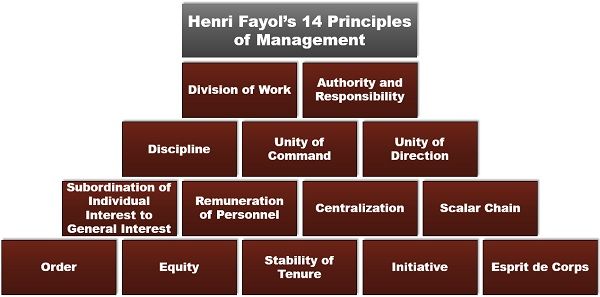
14 Principles of Management by Henri Fayol

The term ‘principles of management’ sounds quite complicated; however, it is merely a set of fundamental truth for effectively and efficiently managing any business organization.

Fayol developed these principles on the grounds of his findings and experience, which he gained throughout his journey in an iron and coal company.

We will now learn about each of these 14 principles in the following description:14 Principles of Management

Division of Work

The first principle emphasizes on dividing the work into smaller tasks which can be equally allotted to individual employees based on their ability, skills and specialization. This is to enhance their overall efficiency in performing their respective duties.

Authority and Responsibility

Giving of responsibility is always accompanied by the delegation of a certain level of authority to fulfil the given task efficiently.

Responsibility without authority may result in improper utilization of the provided resources or delay in task accomplishment. Whereas, power without responsibility may result in reckless attitude and poor leadership.

Discipline

The management must ensure that employees abide by the rules, norms, principles and policies of the organization to maintain a disciplined work environment.

The managers can adopt the techniques of motivation and penalty (in case of non-compliance) for this purpose.

Unity of Command

This principle states that every employee should be headed by only one manager and not by two or three senior authorities.

It creates a lot of confusion for the employee and may lead to conflict among the instructing supervisors or managers.

Unity of Direction

The efforts and individual objectives of all the employees performing various tasks should be directed towards the attainment of the organizational goals as an ultimate aim.

Subordination of Individual Interest to General Interest

The management should understand the individual objectives of each employee so that these personal interest of the employees can be aligned with the organizational interest or purpose.


This principle says that the organization’s goal is superior to the individual aim of the employees.

Remuneration of Personnel

The remuneration policy (i.e., payment of wages and salary) of the employer should be fair enough. This is to ensure employee satisfaction, and it should either match or exceed the remuneration provided by the competitors.

centralization 

The level to which the authority of decision-making is delegated to the subordinates depends upon the organization’s size, type, nature and situation.

Usually, the large companies require decentralization however, small firms may carry on with a centralized approach.

Scalar Chain

The organizational structure should be such that the employees can follow a clear hierarchy. Thus, everyone knows to whom they are accountable and, a smooth flow of information can be maintained from top to bottom level and vice-versa.

However, in case of an emergency or situation demanding quick decision-making, this concept may create a hurdle.

Therefore, for such circumstances, Fayol has given the idea of ‘gangplank’. That is, an employee at any level can break the scalar chain and communicate with the other employee belonging to any authority level.

Order

Here, order refers to organizing everything (i.e., all the resources) in a systematic and planned manner.

In short, every object should have a pre-decided place, and every employee must be placed in the right role or job position.

Equity

According to Fayol, the management should never discriminate between the employees and treat them as equal in all respect.

If the organization is impartial towards its staff, they too tend to develop trust and belongingness towards the company.

Stability of Tenure

This principle is related to the retention and attrition of employees.

The growth of any business depends upon its ability to retain its employees for a long-term since  recruitment, selection and training of new personnel involves enormous cost and time.

Initiative

The organization must encourage and inspire its employees to give their input and take the initiative in the execution of the planned activity.

It not only brings out innovative and creative ideas but also motivates the employees to perform their best.

Esprit de Corps

Teamwork is an essential part of any business, and therefore, the organization should ensure that there is a cordial relation among the employees.

It develops a unity, team spirit, loyalty, mutual understanding and positive work environment in the organization.

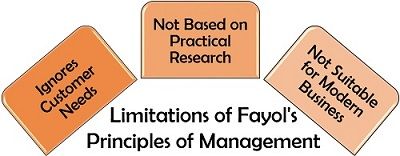
Limitations of Fayol’s Principles of Management

Later on, Fayol’s 14 principles of management were criticized by many management critics. To know the reasons for this criticism, read below:Limitations of Fayol's Principles of Management

Fayol’s principles revolve around catering to the needs of the organization; however, customer needs and demand are entirely ignored in this approach.

These principles are not based on practical research; instead, Fayol gave this concept as per his personal experience.

The 14 principles of management were developed in the period 1900s when the business scenario was very different from today. Therefore these are not exactly suitable for the present era and needs modification.

Managerial economics PDF notes

Management Organisational Behaviour

Management Organisational Behavior

Everything you need to know about organisational behavior. The field of organisational behavior deals with human behavior in organisation.It is the multidisciplinary field that seeks knowledge of behavior in organisational settings by objective based on studying individual, group and organisational processes.The role and field of organisation behavior is not only concerned with a particular organisation. The concepts and approaches of organisation behavior are also more concerned with the society.

The study of Organizational Behavior (OB) is very interesting and challenging too. It is related to individuals, group of people working together in teams. The study becomes more challenging when situational factors interact. The study of organizational behavior relates to the expected behavior of an individual in the organization.

No two individuals are likely to behave in the same manner in a particular work situation. It is the predictability of a manager about the expected behavior of an individual. There are no absolutes in human behavior. It is the human factor that is contributory to the productivity hence the study of human behavior is important. Great importance therefore must be attached to the study.

Researchers, management practitioners, psychologists, and social scientists must understand the very credentials of an individual, his background, social framework, educational update, impact of social groups and other situational factors on behavior.

Managers under whom an individual is working should be able to explain, predict, evaluate and modify human behavior that will largely depend upon knowledge, skill and experience of the manager in handling large group of people in diverse situations. Preemptive actions need to be taken for human behavior forecasting.

The value system, emotional intelligence, organizational culture, job design and the work environment are important causal agents in determining human behavior. Cause and effect relationship plays an important role in how an individual is likely to behave in a particular situation and its impact on productivity.

An appropriate organizational culture can modify individual behavior. Recent trends exist in laying greater stress on organizational development and imbibing a favorable organizational culture in each individual. It also involves fostering a team spirit and motivation so that the organizational objectives are achieved.

There is a need for commitment on the part of the management that should be continuous and incremental in nature.

In words of K Aswathappa, “OB is the study of human behaviour in organisational setting, of the interface between human behaviour and organisation and of the organisation itself.”

In words of Stephen P. Robbins, “OB is a field of study that investigates the impact that individuals, groups and structures have on behavior within organisations for the purpose of applying such knowledge towards improving an organisation’s effectiveness.”

According to L. M. Prasad, “Organisational behavior can be defined as the study and application of knowledge about human behavior related to other elements of an organisation such as structure, technology and social systems.”

According to Davis and News-tram, “Organisational behavior is the study and application of knowledge about how people act within organisations.”

According to Fred Luthans, “Behavior is directly concerned with the understanding, prediction and control of human behaviour in organisations.”

In words of John News-tram and Keith Devis, “Organisational behaviour is the study and application of knowledge about how people as individuals and as groups act within organisations. It strives to identify ways in which people can act more effectively.”

OB is the study of individual behaviour in isolation, when in group and as a part of an organisation. The study of individual behaviour only, would be incomplete because behaviour is affected by the people surrounding us as well as by the organisation, in which we work. Studying only individuals or only organisations would be of no use. It is essential to study both simultaneously.

Personality, perception, learning, attitude, family background, training, motivation, job satisfaction, performance appraisal, leadership effectiveness, norms, values and ethics are the factors which affect the individual behaviour. Group dynamics, communication, organisational environment, individual and organisational culture affect group behaviour. Organisational structure, power & politics, status, relation with juniors & seniors, conflicts and culture affect the individual behaviour in the organisation.

The nature it has acquired is identified as follows:

1. A Separate Field of Study and Not a Discipline Only:
2. An Interdisciplinary Approach:
3. An Applied Science:
4. A Normative Science:
5. A Humanistic and Optimistic Approach:
6 A Total System Approach:

By definition, a discipline is an accepted science that is based on a theoretical foundation. But, O.B. has a multi- interdisciplinary orientation and is, thus, not based on a specific theoretical background. Therefore, it is better reasonable to call O.B. a separate field of study rather than a discipline only.

Organizational behaviour is essentially an interdisciplinary approach to study human behaviour at work. It tries to integrate the relevant knowledge drawn from related disciplines like psychology, sociology and anthropology to make them applicable for studying and analyzing organizational behaviour.

The very nature of O.B. is applied. What O.B. basically does is the application of various researches to solve the organizational problems related to human behaviour. The basic line of difference between pure science and O.B. is that while the former concentrates of fundamental researches, the latter concentrates on applied researches. O.B. involves both applied research and its application in organizational analysis. Hence, O.B. can be called both science as well as art.

Organizational Behavior is a normative science also. While the positive science discusses only cause effect relationship, O.B. prescribes how the findings of applied researches can be applied to socially accepted organizational goals. Thus, O.B. deals with what is accepted by individuals and society engaged in an organization. Yes, it is not that O.B. is not normative at all. In fact, O.B. is normative as well that is well underscored by the proliferation of management theories.

Organizational Behavior applies humanistic approach towards people working in the organization. It, deals with the thinking and feeling of human beings. O.B. is based on the belief that people have an innate desire to be independent, creative and productive. It also realizes that people working in the organization can and will actualize these potentials if they are given proper conditions and environment. Environment affects performance or workers working in an organization.

The system approach is one that integrates all the variables, affecting organizational functioning. The systems approach has been developed by the behavioral scientists to analyse human behaviour in view of his/her socio-psychological framework. Man’s socio- psychological framework makes man a complex one and the systems approach tries to study his/her complexity and find solution to it. 

Management Organization Behavior notes PDF


A STUDY ON CONSUMER PERCEPTION OF SERVICE QUALITY FOR SRI VINAYAKA AUTOMOBILES, PALAMANER

A STUDY ON CONSUMER PERCEPTION OF SERVICE QUALITY FOR SRI VINAYAKA AUTOMOBILES, PALAMANER The ultimate aim of every business is to increas...